
Looking for an All-in-One Mortgage? Here Are 10 Things to Know About Interest, Fees, and Cash Flow
An all-in-one mortgage or account structure combines some banking functions that are usually kept separate. Depending on the lender and product, the structure may coordinate income deposits, mortgage borrowing, a line of credit, bill payments, and available cash.
This arrangement may help some borrowers manage cash flow. It is not automatically cheaper or suitable for every household.
The key requirement is to understand how interest, repayment, fees, qualification, and re-borrowing work before proceeding.
How traditional banking can dilute repayment power
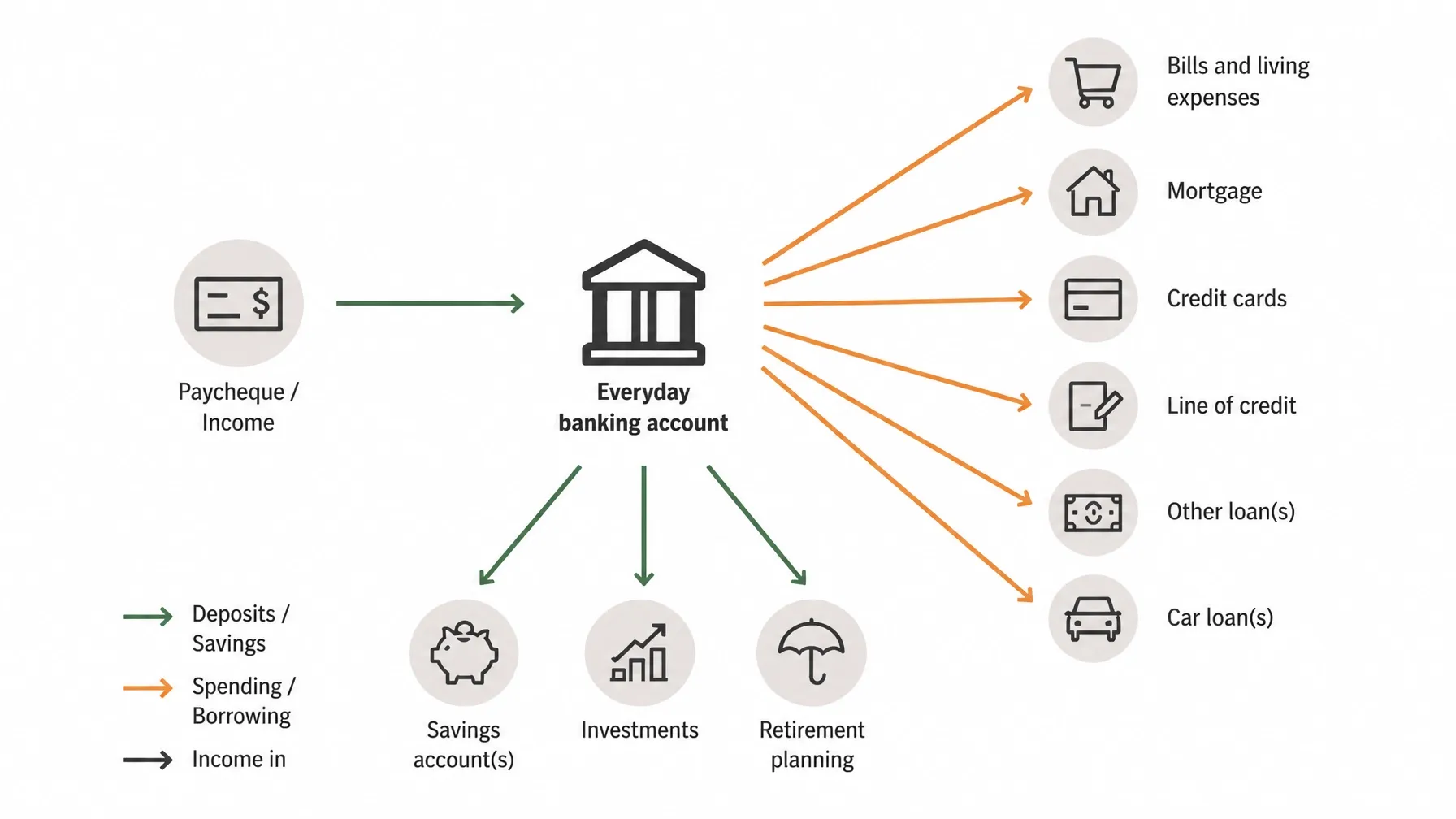
A typical paycheque may be distributed across:
- A mortgage payment
- Credit card payments
- Personal loan payments
- A line of credit
- A vehicle loan
- Bank account fees
- Interest charges
- Household bills
- Savings and investment contributions
- Insurance premiums
Each item may be reasonable on its own. The combined effect can reduce the cash available for principal repayment and long-term planning.
Credit cards, personal loans, lines of credit, and other borrowing products may also have higher interest rates and separate fees than a mortgage, depending on the product, lender, and borrower. The result can be fragmented cash flow and several repayment dates.
An all-in-one structure may coordinate eligible borrowing and cash flow in one place. The potential benefit comes from how the account is used: not from the account name alone.
1. Understand semi-annual compounding
Canadian fixed-rate mortgages commonly use a nominal annual rate compounded semi-annually, not in advance. This means the quoted mortgage rate is converted into an equivalent payment rate for monthly, biweekly, or weekly payments.
Product terms can vary. Variable-rate, line-of-credit, readvanceable, and other account structures may calculate interest differently, often using a variable rate and daily balance calculations.
Confirm the following before signing:
- The stated interest rate
- The compounding convention
- How often interest is calculated
- Whether the rate can change
- How interest is applied to borrowed and deposited funds
Use the Financial Consumer Agency of Canada mortgage calculator to test payment and interest scenarios.
2. Recognize how amortization affects early payments
An amortization period is the estimated time required to repay the mortgage if scheduled payments continue under the stated assumptions.
At the beginning of an amortized mortgage, the outstanding balance is highest. As a result, more of each payment generally goes toward interest and less goes toward principal.
Over time:
- The balance decreases
- The interest portion generally decreases
- The principal portion generally increases
- The same scheduled payment can produce a different interest-principal split
This is often described as a front-loaded interest schedule. It does not mean the lender is applying an arbitrary penalty to early payments. It results from calculating interest on the remaining balance.
Review the full amortization schedule. Do not evaluate a mortgage by the first monthly payment alone.
3. Examine the cash-flow mechanics
An all-in-one account may allow income deposits to reduce the balance on which interest is calculated. Household expenses are then paid from the same account or linked structure.
Potential advantages may include:
- Fewer accounts to monitor
- Coordinated income and bill payments
- Daily cash balances applied according to product rules
- Access to available borrowing as principal is repaid
- A clearer view of total household borrowing
The result depends on timing, balances, payment behaviour, and lender rules. A paycheque deposited into an account does not automatically create permanent debt reduction if the funds are later spent or re-borrowed.
4. Compare every product cost
A mortgage may have a lower interest rate than some unsecured borrowing products. However, the comparison must include the complete cost.
Review:
- Mortgage interest
- Line-of-credit interest
- Annual or monthly account fees
- Legal fees
- Appraisal fees
- Registration or discharge fees
- Setup charges
- Transaction fees
- Insurance costs
- Prepayment charges
- Interest-rate adjustment provisions
Credit cards, personal loans, vehicle loans, and lines of credit can carry different rates and fee structures. Obtain the cost-of-borrowing disclosure for each option.
Do not compare products based only on the advertised rate or monthly payment.
5. Calculate the full cost when moving balances
Moving eligible balances into a coordinated structure or secured borrowing structure can lower the required monthly payment. That does not necessarily reduce the total cost.
A lower payment may result from extending repayment over a longer amortization. Interest may then be charged for more years. The total interest can increase even if the new interest rate is lower.
Before moving balances, calculate:
- The current balance of each liability.
- The current interest rate and payment.
- The remaining repayment period.
- The fees and penalties required to move the balance.
- The new payment.
- The new repayment period.
- The total interest under each option.
- The result if the balance is re-borrowed later.
Request a written comparison. Confirm whether the proposed structure improves monthly cash flow, total borrowing cost, or both.
6. Confirm qualification and lender approval
An all-in-one mortgage or account structure is subject to lender criteria. Approval is not based only on the value of the property.
The lender may review:
- Income
- Employment or business documentation
- Credit history
- Existing debts
- Property value
- Loan-to-value ratio
- Payment obligations
- Stress-test qualification
- Intended use of borrowed funds
- Existing mortgage terms
A mortgage professional can review available options across the lender panel. Final approval, rates, terms, and features remain subject to the selected lender.
7. Review prepayment privileges
Prepayment privileges determine how you can reduce principal without triggering a charge.
Ask whether the product permits:
- Annual lump-sum payments
- Increased regular payments
- Payment doubling
- Accelerated payment schedules
- Principal reductions at renewal
- Direct application of excess funds to the mortgage balance
Confirm the limits, timing, and administrative process. Unused privileges usually do not carry forward, but product rules vary.
8. Check penalties, portability, and charge type
Mortgage flexibility depends on the contract and charge registered against the property.
Review:
- Fixed-rate and variable-rate break penalties
- Interest-rate differential calculations
- Three-month interest provisions
- Portability
- Restrictions on transferring the mortgage
- Collateral charge registration
- Discharge and refinancing costs
- Renewal and conversion rules
- Requirements for increasing the loan
A collateral charge may provide flexibility for additional borrowing, but transferring or discharging it can involve different costs and procedures than a standard charge.
Read the mortgage commitment, product guide, and cost-of-borrowing documents before accepting the structure.
9. Assess spending discipline and re-borrowing risk
An all-in-one account can make borrowing more accessible. This creates a management requirement.
If repayment creates available credit and that credit is repeatedly used for spending, the mortgage balance may not decline as planned. A lower monthly payment can also create room for additional spending without creating an immediate payment shock.
Set operating rules before using the account:
- Deposit employment and business income consistently
- Track discretionary spending
- Set a target principal-reduction amount
- Separate essential expenses from optional purchases
- Avoid using available credit to maintain an unaffordable lifestyle
- Review the balance monthly
- Keep emergency reserves outside the borrowing limit where practical
The account structure cannot replace a household budget or repayment plan.
10. The Big Picture
Increased cashflow and focused priorities on other area of your financial plan like investments and insurace could be enhance with an All in One account.
The right structure depends on your circumstances, qualification, lender approval, product costs, and how the account is managed.
When an all-in-one structure may not fit
Consider a conventional mortgage or separate accounts if:
- You require payment stability
- You prefer strict separation between borrowing and spending
- You do not want variable-rate exposure
- The account fees exceed the expected benefit
- You may sell or refinance before the end of the term
- You are likely to re-borrow available credit
- The product’s collateral charge or penalty structure does not fit your plans
- The lender’s qualification requirements are not met
The correct structure depends on your current cash flow, future plans, risk tolerance, and repayment behaviour.
Questions to ask before proceeding
Ask the lender or mortgage professional:
- How is interest calculated?
- What rate applies to each portion of the account?
- Is the rate fixed, variable, or convertible?
- What fees apply at setup and during use?
- How does income reduce the balance?
- How does re-borrowing affect repayment?
- What happens if the property is sold?
- Can the mortgage be transferred to another lender?
- What penalties apply if the contract is broken?
- What is the total interest under the proposed amortization?
- How much available credit could be created?
- What repayment rules will apply after the term ends?
Next step
Prepare your current mortgage statement, borrowing balances, interest rates, monthly payments, income details, and financial objectives.
Contact Glenn Bauman Mortgages for a Canada-wide review of mortgage structures and cash-flow considerations:
You can also review government guidance on choosing a mortgage, mortgage terms and amortization, and prepayment penalties.
Disclaimer
Rates, qualification requirements, lender approval, fees, penalties, compounding methods, charge types, and product features vary by lender and borrower. Confirm all terms and costs before proceeding. An all-in-one mortgage or account structure may not be suitable for every borrower. This information is for general education and is not investment, insurance, tax, or legal advice.
Best available rates shown are from Glenn Bauman Mortgages lender panel and are subject to your qualification, lender approval, and change without notice. On approved credit (OAC). Your actual rate depends on your credit, down payment, property type, and other lender-specific criteria. Last updated August 29, 2026.